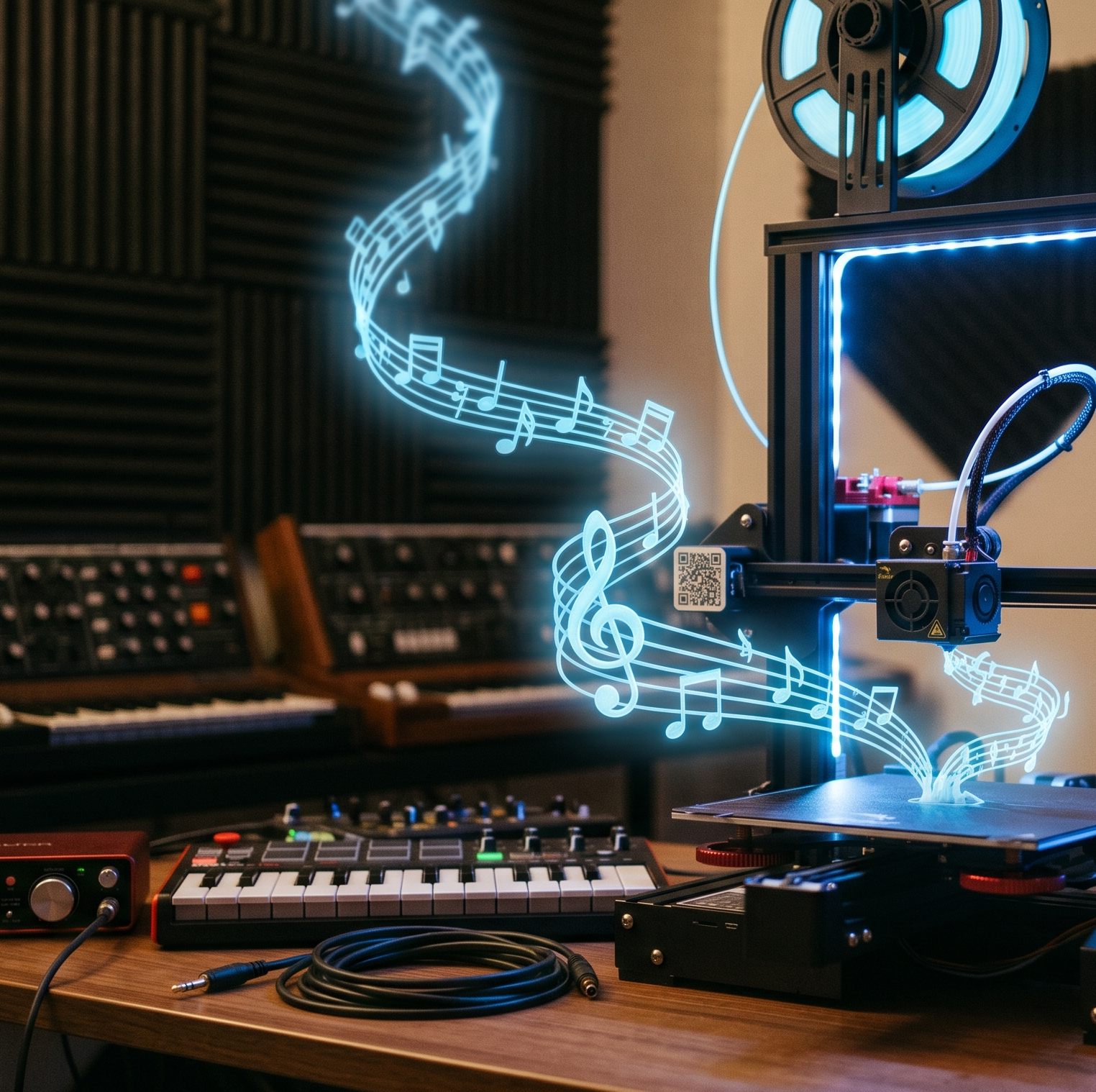
Whether you’re a touring guitarist, a bedroom beatmaker, or a classical cellist, you know that the right gear makes all the difference. But what happens when the exact tool, stand, or accessory you need doesn’t exist—or costs a small fortune?
Enter 3D printing.
Additive manufacturing is no longer just for engineers and cosplay enthusiasts. It has quietly become one of the most powerful tools in a modern musician’s arsenal. From custom-angled synthesiser stands to entirely new acoustic instruments, 3D printing is democratising how we create, modify, and interact with our music gear.
Here is a look at the major benefits of integrating 3D printed solutions into your musical workflow.
1. Ultimate Customisation and Ergonomics
Standardised gear assumes every musician plays the same way, in the same space, with the same body mechanics. 3D printing shatters that limitation.
- Tailored Synth & Device Stands: Got a drum machine that sits too flat on your desk? You can print a stand angled at precisely 25 degrees to save your neck and improve workflow.
- Custom Instrument Details: Guitarists can print custom pickguards, volume knobs, or thumb rests that fit their exact hand size and playing style.
- Ergonomic Adapters: Drummers and percussionists are using flexible TPU filaments to print custom grips for sticks and mallets, reducing hand fatigue during long sessions.
“With 3D printing, you are no longer forcing your creative process to fit the gear; you are molding the gear to fit your creative process.”
2. Cost-Effective Replacements and Repairs
Vintage gear is notoriously difficult to maintain. When a proprietary knob on a 1980s Roland synthesiser breaks, finding an original replacement can involve months of scouring auction sites and paying exorbitant markups.
3D printing offers an immediate, cost-effective alternative. With a pair of digital calipers and some basic CAD software (or by searching open-source libraries), you can model and print a replacement part in less than an hour for pennies.
Traditional vs. 3D Printed Replacements
| Gear Issue | Traditional Solution | 3D Printed Solution |
| Lost fader cap | Buy a generic pack (£10) or hunt for vintage (£25+) | Print a custom-fit cap in 10 minutes (£0.05) |
| Broken mic clip | Order a new one and wait for shipping (£15) | Print a reinforced PETG clip immediately (£0.50) |
| Missing battery door | Duct tape / Buy a broken unit for parts (£40) | Download and print an exact replica (£0.30) |
3. Radical Acoustic Innovation
While much of 3D printing in music revolves around accessories, the technology is also revolutionising the instruments themselves.
Traditional instrument manufacturing relies on subtractive processes (carving wood) or injection molding. 3D printing allows for complex internal geometries that are otherwise impossible to create. Makers are experimenting with intricate, honeycomb-like internal acoustic chambers in printed violins and acoustic guitars, manipulating resonance and tone in completely new ways.
Furthermore, modern exotic filaments—like carbon-fiber infused nylon or wood-filled PLA—offer unique acoustic properties, durability, and aesthetics that rival traditional materials.
4. Solving the Cable and Space Chaos
Any studio engineer or live performer knows the nightmare of cable management and shrinking desk space. 3D printing allows you to build hyper-specific organizational systems.
- Under-Desk Mounts: Free up desk real estate by printing custom brackets to mount audio interfaces, power strips, or headphone amps directly under your workspace.
- Modular Pedalboards: Instead of buying a heavy, fixed-size aluminum pedalboard, you can print a modular, interlocking board that grows or shrinks depending on your current pedal chain.
- Bespoke Cable Clips: Print routing clips sized exactly for your thickest quarter-inch cables or your thinnest MIDI cords.
5. The Power of Open Source Communities
Perhaps the greatest benefit of 3D printing for musicians isn’t the hardware, but the community. You don’t need to be a 3D modeling expert to reap the rewards.
Websites like Printables, Thingiverse, and MakerWorld host thousands of free files uploaded by other musicians. From custom wall-mounts for specific guitar models to interlocking Eurorack cases, chances are someone has already encountered the exact problem you have—and uploaded the solution for free.
Ready to Hit Print?
You don’t even need to own a 3D printer to get started. Local libraries, maker spaces, and online on-demand printing services make it incredibly easy to turn a digital file into a physical piece of gear.
The next time you find yourself frustrated by an awkward studio setup, a broken part, or a missing accessory, ask yourself: Could I print a solution for this? More often than not, the answer is a resounding yes.